

Nick Downham – Sept 2020
© Cressbrook Ltd 2020 – All Rights Reserved
Questioning the work is pre-requisite to transformation
One of the traps organisations fall into when seeking to improve or transform is not taking time to understand the true nature of their work. Put simply, they fail to question their work (Anderson Wallace & Downham forthcoming).
The consequences of this are profound. They range from making the wrong work efficient, to re-enforcing current structures and models – locking in ways of working. This is a core reason truly transformational work is so uncommon. By not questioning the work, we make the current better, rather than do better things (Anderson-Wallace & Malby 2016).
Transform:
To change:
*composition or structure,
*outward form or appearance,
*character or condition.
Source: Mirriam-Webster.com accessed June 2020.
It implies a major change in form, nature and function.
The limitations of looking at existing datasets
If done correctly, improvement starts with demand analysis. After all, how can you improve a service without knowing how much work it has to do? Many organisations jump into analysing their activity data to answer this question – but activity data only tells you who you let in, rather than who needed to be seen. If you are lucky, these may be the same, but in most cases they are not. Activity data commonly also has a lag in it. It tells you when someone presented or had an intervention, but it does not tell you when the need arose.
Understanding demand, as a figure is also not enough. We need to understand the nature of the work – in order to design services to meet that need. Demand only reduces if you meet it, not manage it – and in healthcare that starts with need. I am explicitly using the word design as this is a very deliberate process, as opposed to gradual evolution, based on fire fighting pressures, that drives much service development.
Viewing the work differently
The other problem with much demand data is it tends to be based around labeled needs (Davis 2015). These labeled needs mirror the current system design, structures and response. In other words it, again, reinforces the current structures. If we truly want something different (transformational), we need to view the work differently. This is sometimes referred to as the difference between first order change (changes consistent with the already present schemata – the pattern of thoughts, logic and corresponding model and structure) and second order change (change the schemata itself) (Bartunek & Moch 1987).
A practical example of this would be to look at the front door of most healthcare systems – called Primary Care and specifically General Practice in the English NHS. Looking at this common first point of access can give us important insights beyond primary care and into the pressures more specialist secondary care hospital settings face.
Starting from the position of needing a new view, I am an advocate of keeping things simple. There are a large number of system archetypes to consider when trying to understand the work, but in healthcare two broad archetypes are particularly useful when beginning this journey.
Linear work:
A largely process driven bio-medical response to helping people. Examples are a test in secondary care, an onward referral to a clinical specialist or medical assessment. Other examples would be the diagnosis and treatment of a cancer or a surgical intervention.
This work can be highly technical in nature. Success is generally reliant on process steps coming together with high reliability (this is sometimes described as transactional work). It is generally highly specified in form and timing. Much commissioning of services assumes work is linear in nature.
Characteristics of linear work:
*Highly defined in process.
*Specified in nature, entry criteria and timing.
*Transactional relationships between the various parts of the process.
*High degree of certainty and reliability of interventions and timing define outcomes.
*Can be hugely technical in nature (such as a surgical intervention).
*Outcomes and standards can be easily defined.
*Pathways and processes are split amongst functionally specialized providers, teams and professionals.
*Market and financial incentives are used as management tools.
*The life context of the patient does not limit the outcomes of the intervention in the short and medium term.
*Delivered through hierarchical structures.
*Improved through Quality Improvement (QI) techniques (process mapping and waste identification).
Relational work:
A response that may include, but is largely concerned with factors outside the bio-medical. Such as the person’s environment and social circumstances (see my blog on social context in healthcare – Downham & Easton 2020). An example would be helping someone with type 2 diabetes, or trying to slow the disease progression of someone with COPD. This work centres on a person’s life and lifestyle – such as their network and wider determinants of health. The work of Becky Malby (Malby 2019), Richard Davis (Davis 2016) and the late Julian Pratt (Pratt 1995) are good further reading in understanding this kind of work.
Characteristics of relational work:
*System designed to be able to iteratively help someone (to loop and try again multiple times).
*Adopt asset based (LSBU 2019) starting points with patients – what makes you well vs what makes you ill (The Health Foundation 2015).
*High degree of flexibility to help the patient ‘do what matters’ to them and help them take control of their lives (Marmot 2010).
*High degree of continuity avoiding deferring and referring where possible.
*Emphasis on helping the patient create a support network and sense of purpose.
*Time for professionals to create trust and relationships.
*Long term funding arrangements.
*Enabled through network based structures.
*Improved through systems thinking.
The important thing about these two archetypes is you need to organise and design services differently to achieve them.
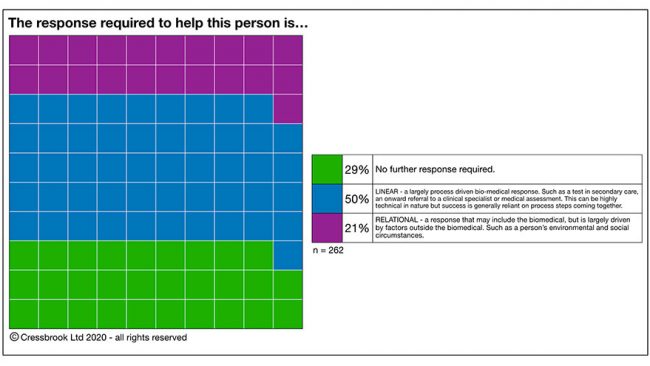
The graphic below illustrates the split of these two work architypes as seen by a typical general practice over a week. This practice was in a relatively deprived urban area. Looking at the 262 consultations analysed, the green represents patients who required no further action, the blue represents patients who needed a linear response, and the purple represents patients who needed a relational response.
It shows that 29% of patients required no follow up at all. 50% required a classic bio-medical response (what the service is predominantly set up to do) and a very considerable 21% of people required a relational response.
What does this mean to the way general practice and the wider system works?
The NHS, including primary care, is overwhelmingly set up to treat bio-medical conditions in a reactive manner – linear work. Over the past decades pathways and specifications of work have been getting more numerous, defined and performance managed. This transactional, process driven work has become more and more dominant. The assumption is work can be labelled, specified, broken down into parts and will follow a documented process. In our example of GPs, the options available to GPs in order for them to help someone are, in the vast majority, linear. For example to refer onwards or prescribe.
So what does this dominance of linear biomedical capability mean with the 20+% of people (this equates to hundreds of thousands of people per week across the country), who need a relational response? A response that helps them with their life context. It means the NHS has a far less capacity and a far less capable response. We are simply not set up for it – it is not core business. Even in general practice, GPs are in many contractually tied (due to access measures) to 10 minute appointments that limit relational work. Many services that could help don’t have the capacity and as a result have very high criteria for entry.
The consiquence of this is that, as a country, we struggle with lifestyle related conditions (relational work) such as diabetes, COPD, obesity and MH provision. For type 2 diabetes alone the NHS estimates the cost to the NHS to be £8.8 billion (NHS DPP 2020). Due to poor continuity, lack of time and fragmented systems (multiple services and professionals), relationships and trust is difficult to form and maintain with patients. Without a relationship and trust it is very difficult to help someone with their lifestyle. Of course, as detailed in reports like the Marmot review (Marmot 2010), people cannot make lifestyle choices if the problem is actually their life context and social circumstances.
So a GP ends up having to fit a social presentation into a biomedical box. Or prescribe against something that has a social root cause, or just diligently clinically manage someone’s decline in wellbeing as there is no effective way of helping them. As Abraham Maslow stated, if all you have is hammer (a health one), then you have to see everything as a nail.
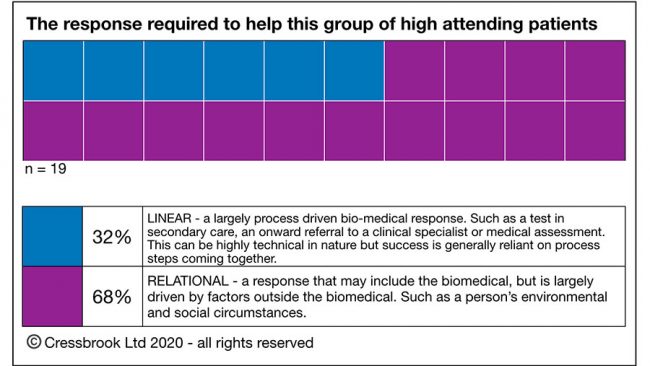
As illustrated in the graphic below, this plays out when you use the same analysis to look at a practices high attenders. The practice reviewed 19 high attenders. These high attenders accounted for 1165 practice interactions (F2F or tele consultation) and minimum of 265 secondary care interactions in the previous year. Of these 19 high attenders 68% required a predominantly realational response to help them. High attending patients, in the majority, are not a biomedical issue.
To meet this demand, a practice needs a model that is capable of relational work. Small steps like social prescribing can be helpful, but given the proportions, it is in a practice’s best interest to shift to a much more relational model if it truly desires transformation.
At regional and policy level. if the NHS is ever to meet its self identified targets of reducing demands on secondary care, greater anticipatory care, reducing health inequalities and improving long term conditions then it has to get really good at relational work.
The first step to stop assuming all the work is linear.
This accompanying blog (Downham 2020a) details some specific forms of organising and interventions General Practice can consider when trying to build relational and linear capability.
References:
- Bartunek, J & Moch, M,. (1987) First-Order, Second-Order and Third-Order Change and Organisational Development Interventions: A Cognitive Approach
- Anderson-Wallace, M & Downham, N,. (Forthcoming) Questioning the Work, Sage
- Anderson-Wallace & Malby R (2016),. Managing Networks in Healthcare, Emerald
- Downham, N,. (2020),. Innovation in Primary Care [online] https://www.cressbrookltd.co.uk/innovation-in-primary-care-and-primary-care-networks-new-perspectives-on-the-work/ accessed June 2020
- Downham, N,. (2020a),. Characteristics of Linear and Relational Work in General Practice [online] https://www.cressbrookltd.co.uk/linearandrelationalworkingeneralpractice/ accessed Sept 2020
- Downham, N & Easton C (2020),. The Reality of Patient Context in General Practice [online] https://www.cressbrookltd.co.uk/the-reality-of-social-context-gp/ accessed June 2020
- Davis, R (2016),. Responsibility in Public Services, Triarchy Press
- Health Foundation (2015),. [online] https://www.health.org.uk/sites/default/files/2018-09/headhandsandheartassetbasedapproachesinhealthcare_inbrief.pdf accessed June 2020
- LSBU (2019),. Asset Based Health Enquiry, London South Bank University
- Marmott, M (2010) Fair Society, Healthy Lives – Strategic Review of Health Inequalities
- Malby, R (2019) Learning Journeys [online], https://beckymalby.wordpress.com/
- NHS DPP (2020),. NHS Diabetes Prevention Programme, [online], https://www.england.nhs.uk/diabetes/diabetes-prevention/ accessed June 2020
- Pratt , J,. (1995) A Conflict of Values, CRC Press
Nick Downham – Sept 2020
© Cressbrook Ltd 2020 – All Rights Reserved